-
Your location:
- Home
- > News
- > About company
E-SHEN Technology Co., Ltd.


Your location:
All-optical networks have become a hot topic in recent years. In our previous article, Hengshen Technology shared how, driven by both customer applications and technological advancements, all-optical networks are inevitably becoming the future of next-generation campus networks.
Currently, the mainstream view in the industry is that all-optical networks generally use single-mode fiber as the medium, employing Ethernet switching equipment or PON equipment for networking. This allows for some photoelectric conversion between device nodes. Therefore, all-optical networks include two main categories: Ethernet all-optical and PON (Passive Optical Network).
So, what are the key technologies used in all-optical networks? What are the application solutions in different scenarios? Today, Hengshen Technology will provide a systematic introduction.
First, let's introduce PON networks. Let's look at a schematic diagram of a PON network.
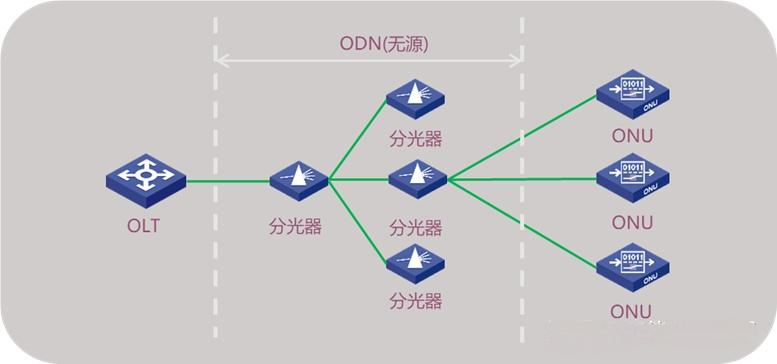
Figure 1. Schematic Diagram of PON Network Structure
PON networks involve the following three most important all-optical technologies:
1. Data Transmission and Reception in PON Networks. The most critical communication network elements in a PON network are called OLT (Optical Line Terminal) and ONU (Optical Network Unit).
2. ODN Network (Optical Distribution Network), whose function is to provide an optical transmission channel between the OLT and ONU.
3. PON Network Redundancy Protection Technology, providing equipment redundancy and link redundancy to ensure high reliability.
The following provides a detailed introduction to PON network data transmission and reception, ODN network, and PON network redundancy protection technology:
I. Data Transmission and Reception in PON Networks
Although EPON and GPON use different encapsulation and processing technologies, the mechanism for optical transmission and reception between the OLT and ONU is similar.
First, the ONU is registered with the OLT, which assigns a unique ID to each ONU. Then, the OLT issues different configurations to each ONU. Finally, the data is processed according to the corresponding protocol, converted into optical signals for transmission and reception.
The data sent from the OLT to the ONU is called "downlink" data, and the propagation method is P2MP, which stands for point-to-multipoint.
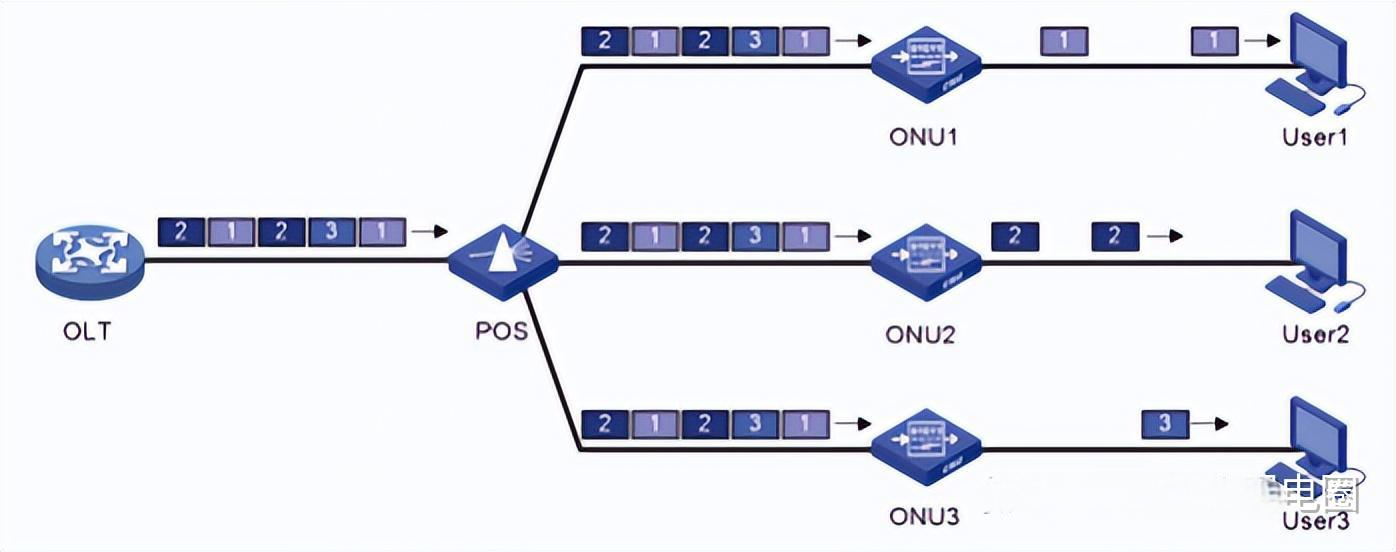
Figure 2. Schematic diagram of OLT downlink broadcast mode (Note: POS is short for optical splitter)
As shown in Figure 2, the OLT marks the data sent to the ONU with the ONU's ID and then merges them into one transmission. The optical splitter then divides the data into multiple equal parts according to the splitting ratio and sends them to the ONUs. The ONU only processes the data marked with its own ID and discards data that does not belong to it.
Conversely, the data sent by the ONU to the OLT is called "uplink" data, which uses time-division multiplexing to achieve many-to-one communication. Each ONU's transmission time slot is uniformly allocated by the OLT, and each ONU can only transmit data in its assigned time slot. The time slot allocation principle can be configured according to different service requirements. The simplest method is average allocation, or it can be based on the service priority connected to the ONU to ensure the quality of high-priority services.
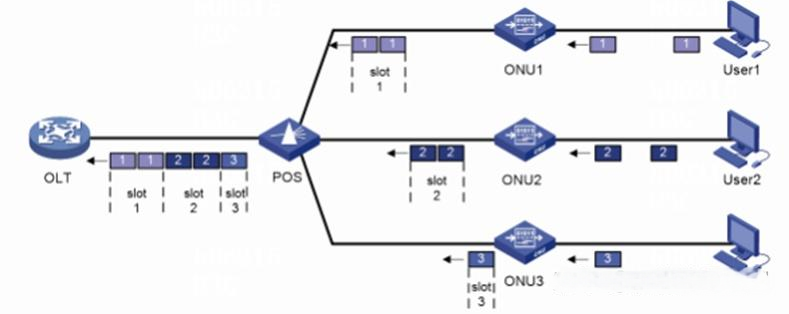
Figure 3. Schematic diagram of OLT data uplink time-division multiplexing.
As shown in Figure 3, each ONU buffers the data received from the user and then transmits it at full speed in its assigned time slot (slot x). Uplink data is combined into a single stream by the optical splitter and sent to the OLT. The OLT then resolves the data from different ONUs based on the allocated time slots. In Figure 3, ONU1 and ONU2 are allocated longer time slots, while ONU3 is allocated fewer. Furthermore, ONU1 has the earliest available time slot in a transmission cycle, meaning its data is always sent with the highest priority, while ONU3 can only handle a small amount of uplink data transmission.
From the data transmission method of the OLT and ONUs, it can be seen that this method is very suitable for scenarios requiring high-speed downloads. However, for scenarios primarily requiring high-speed uploads, the advantages of using a PON network are not obvious.
II. ODN Network
The characteristics of an ODN network are: passive, physical optical splitting, and no alteration of the information carried by the light.
An ODN network mainly consists of optical fibers and optical splitters (also called POS), employing a tree-structured optical splitting method. Single-stage or multi-stage optical splitting can be used depending on deployment needs. It generally does not exceed the second-order spectral separation.